
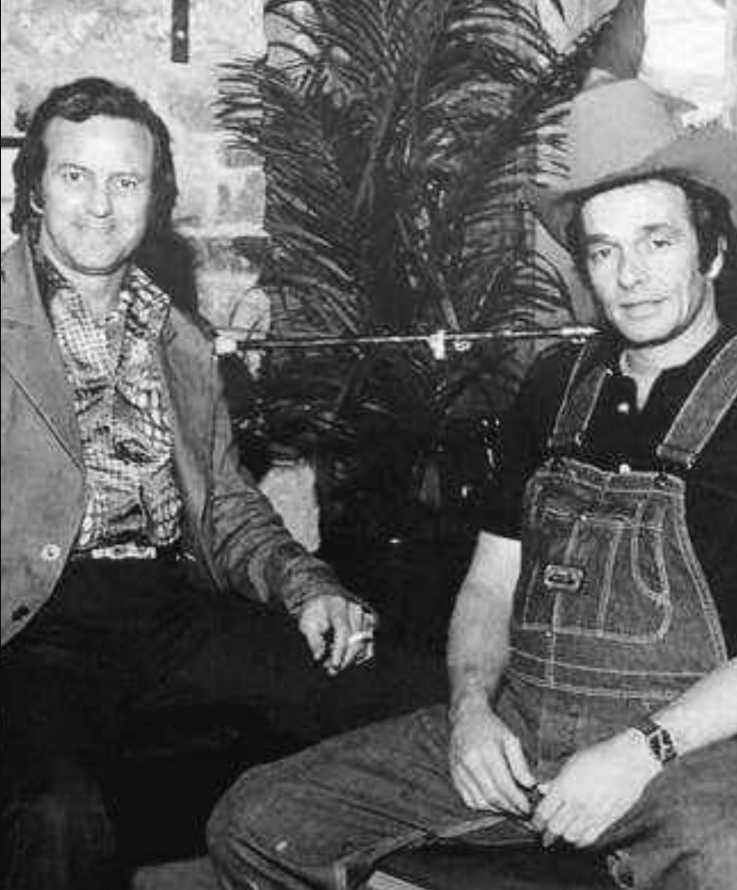

When Merle Haggard released a new single in February 1981, country radio listeners were initially confused by its minimalist, one-word title. Titled simply “Leonard,” the track quickly gained traction, ultimately rising to No. 9 on the Billboard Hot Country Singles chart.
While the general public was unfamiliar with the name, Haggard was paying tribute to a man who had not used his given name in public for nearly three decades.
That man was Leonard Raymond Sipes. The country music world knew him as Tommy Collins, an influential artist and songwriter whose life had taken a dramatic downward turn before Haggard stepped in to help.
A Tribute Song to a Friend and Early Mentor
Haggard originally recorded “Leonard” in 1980 for his hit album Back to the Barrooms, the same record that produced his iconic No. 1 drinking anthem, “I Think I’m Just Stay Here and Drink.” Written entirely by Haggard, the track was far more than a fictional story; it was an intimate tribute to a mentor who shaped his early career.
In the lyrics, Haggard reflected on what Collins meant to him during his early days in the music business. He credited Collins with inspiring his craft and teaching him the intricacies of writing country music.
Haggard even included personal memories, such as Collins bringing him groceries during lean years before “Okie from Muskogee” launched Haggard into superstardom. By deliberately using the title “Leonard” instead of his stage name, Haggard bypassed the performer persona to honor the real man beneath it.
The Rise and Fall of Bakersfield Pioneer Tommy Collins
To appreciate the profound impact of Haggard’s tribute, one must understand the heights Collins reached and the struggles that followed. Born in Bethany, Oklahoma, in 1930, Leonard Sipes helped pioneer the Bakersfield sound. He performed alongside a young Buck Owens as his lead guitarist.
Collins scored notable hits with witty tracks like You Better Not Do That. He authored If You Ain’t Lovin’ (You Ain’t Livin’), which later became a No. 1 hit for George Strait. Over the course of his lifetime, he penned more than 800 songs.
However, his personal journey was fraught with instability. He left the music industry in the late 1950s to become an ordained minister. He eventually returned to music in the 1960s. By the early 1970s, severe addiction and depression took hold. His marriage to his duet partner, Wanda, ended in divorce, leaving him deeply isolated.
How Haggard Kept His Friend’s Career Alive
Throughout Collins’ hardest years, Haggard provided a vital lifeline by continuously recording his songs. Haggard cut dozens of Collins’ compositions. Two of them reached No. 1 on charts: Carolyn in 1972 and The Roots of My Raising in 1976.
These recordings provided Collins with crucial financial royalties and kept his name relevant within Nashville songwriting circles.
By 1976, a newly sober Collins relocated to Nashville to focus exclusively on songwriting. When Haggard released “Leonard” in 1981, it sparked a major career resurgence for Collins. The Nashville Songwriters Hall of Fame credited Haggard’s Top 10 single with bringing national attention back to the legendary writer.
After the success of Leonard, Collins signed publishing deals with Mel Tillis’ Sawgrass Music and Ricky Skaggs Music. These deals generated hits like New Patches for Tillis in 1984. In 1999, Collins was officially inducted into the Nashville Songwriters Hall of Fame before passing away on March 14, 2000, at age 69.