
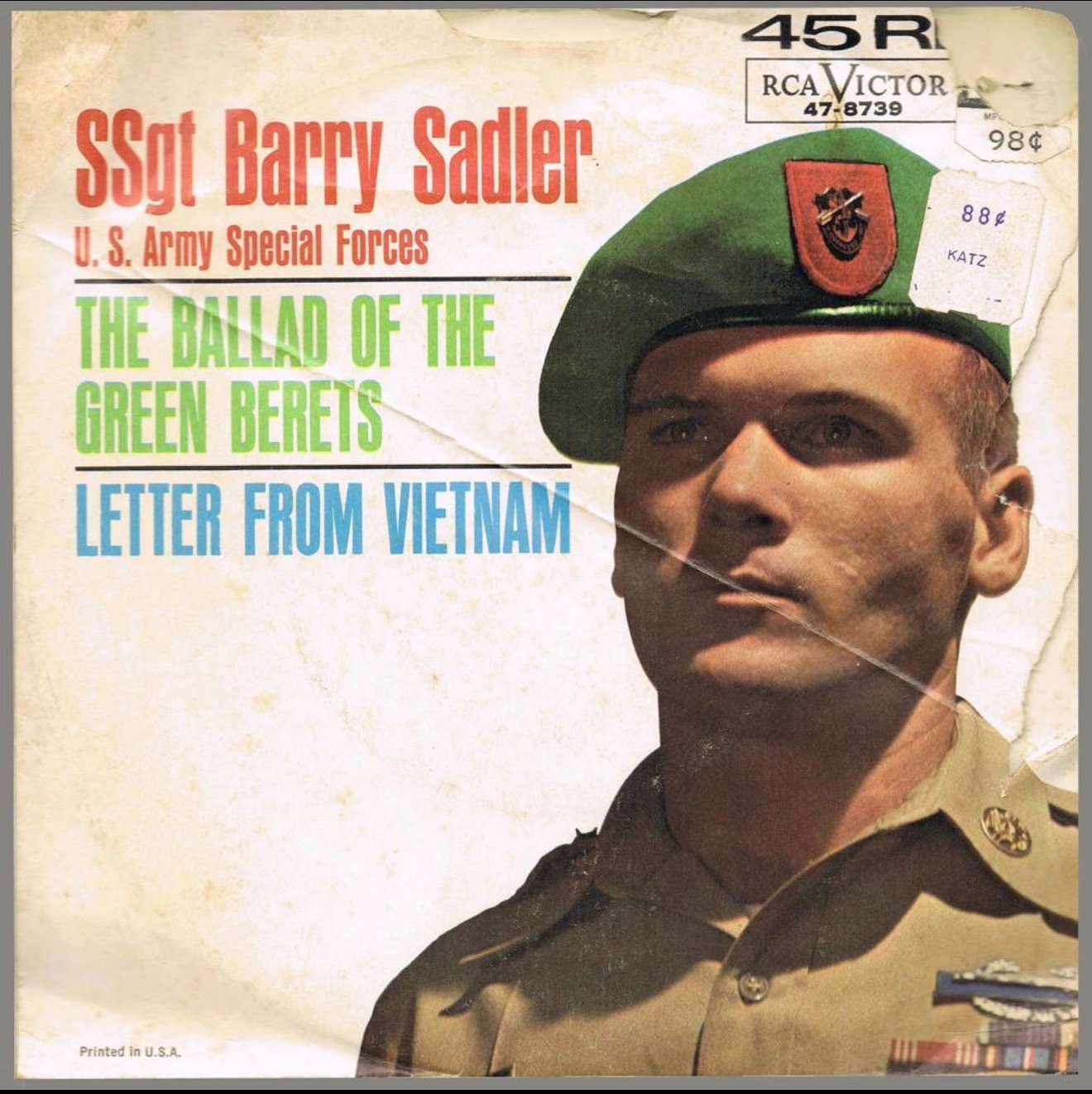

In 1966, a soldier wearing a Green Beret accomplished something few professional musicians could imagine. Staff Sergeant Barry Sadler took a patriotic military ballad to the top of America’s pop charts, where it remained for five consecutive weeks.
Barry Sadler’s “Ballad of the Green Berets” became one of the most remarkable musical success stories of the Vietnam War era.
The song reached No. 1 on the Billboard Hot 100 on March 5, 1966. It remained there through April 2 and later earned recognition as Billboard’s top-ranked single of the year.
What made the achievement extraordinary was the man behind the recording.
Sadler was not an established Nashville star or a member of a famous rock band. He was an Army Special Forces medic who had served in Vietnam and suffered a serious combat-related injury.
His song about the Green Berets became a national sensation, introducing millions of Americans to the soldiers serving in one of the military’s most specialized units.
Yet the story behind the recording is far more complicated than its chart success suggests.
Who Was Barry Sadler?
Barry Sadler was born in New Mexico in 1940 and spent much of his early life moving around the American Southwest.
His path toward music was anything but conventional.
As a young man, he served in the United States Air Force before joining the Army.
He eventually qualified for the Army Special Forces, the elite military organization commonly associated with the distinctive green beret.
Sadler trained as a Special Forces medic, a demanding position requiring both medical knowledge and military skills.
His duties took him to Vietnam during the early years of major American involvement in the conflict.
Unlike most recording artists of the period, Sadler had firsthand experience of the military life he would later describe through music.
That experience became central to his unexpected rise to fame.
A Serious Injury Changed Barry Sadler’s Life
During his service in Vietnam in 1965, Sadler suffered a severe leg injury after encountering a punji stake.
These sharpened stakes were used as traps during the war and could cause devastating wounds.
The injury forced Sadler to leave the combat zone and undergo medical treatment.
His recovery gave him time to work on music.
While recuperating, he developed a song honoring the courage and sacrifices of his fellow Special Forces soldiers.
That composition eventually became “The Ballad of the Green Berets.”
The song was deeply connected to Sadler’s military experience.
Rather than describing an imagined character, he wrote about a world he knew personally.
His experiences as a soldier gave the recording an authenticity that helped distinguish it from other patriotic songs.
The Story Behind “The Ballad of the Green Berets”
Sadler originally developed the song as a tribute to the men serving in Army Special Forces.
The lyrics describe soldiers who undergo demanding training, face dangerous missions, and accept the possibility of losing their lives.
One important influence was the memory of James Gabriel Jr., a Special Forces soldier killed in Vietnam in 1962.
Gabriel was among the early American military casualties of the conflict.
Sadler’s early version of the composition reportedly included a direct reference to him.
Although the commercially released recording did not retain that specific reference, the song’s themes continued to reflect military sacrifice.
Author Robin Moore later helped Sadler revise the composition.
Moore had written The Green Berets, a book that brought attention to the Army’s Special Forces.
Together, they refined the song into a shorter recording suitable for radio.
The finished version combined a marching rhythm, straightforward melody, and lyrics centered on military service.
Those elements helped make it immediately recognizable.
How Barry Sadler’s Song Became a No. 1 Hit
The commercial recording arrived in January 1966 through RCA Victor.
At first, its success seemed unlikely.
The American music charts were dominated by rock, pop, soul, and the British Invasion.
Artists such as The Beatles, The Rolling Stones, and Simon & Garfunkel were attracting enormous attention.
Sadler’s military ballad sounded very different from those recordings.
However, the song quickly found an audience.
Its message appealed to listeners who admired military service and wanted to recognize American soldiers overseas.
Radio stations began playing the recording, and record sales increased rapidly.
On March 5, 1966, “The Ballad of the Green Berets” reached No. 1 on the Billboard Hot 100.
It remained at the top for five consecutive weeks.
The recording also crossed musical boundaries, reaching listeners who normally preferred country, pop, or easy-listening music.
By the end of the year, it had become one of the defining commercial successes of 1966.
The Song Became Billboard’s Biggest Hit of 1966
The achievement was particularly striking because 1966 was an extraordinary year for popular music.
The Beatles continued releasing influential recordings.
The Beach Boys introduced new musical ideas.
Soul performers and rock bands were transforming American radio.
Yet a song performed by an active-duty soldier competed successfully against all of them.
Billboard’s later historical year-end ranking identifies “The Ballad of the Green Berets” as its No. 1 single of 1966.
The recording sold millions of copies, while Sadler’s album Ballads of the Green Berets also became a major commercial success.
His sudden popularity led to national television appearances and extensive publicity.
For a brief period, Sadler became one of the most recognizable recording artists in America.
The success also brought unusual attention to the Green Berets themselves.
Why the Song Was Different From Other Vietnam War Music
The Vietnam War influenced American music throughout the 1960s and early 1970s.
Many songs associated with the conflict expressed concern about war, political decisions, or the experiences of soldiers.
As opposition to the war expanded, protest music became an important part of popular culture.
Sadler’s recording offered a different perspective.
It focused on the courage, training, and sacrifices of individual Special Forces soldiers.
Rather than examining the political reasons for the war, the lyrics presented military service as an honorable calling.
That distinction is important.
The song celebrated soldiers without offering a detailed argument about American foreign policy.
Nevertheless, its popularity reflected the divided cultural atmosphere of the Vietnam era.
Some listeners embraced it as a patriotic tribute.
Others associated it with support for the war.
Today, the recording remains an example of how popular music can reflect competing attitudes during a turbulent historical period.
The Green Berets and Their Place in American Military History
The Green Berets are members of the United States Army Special Forces.
Their missions include unconventional warfare, special reconnaissance, foreign internal defense, and other specialized operations.
The organization became particularly visible during the Cold War and the Vietnam War.
Special Forces personnel often worked closely with partner forces and operated in difficult environments.
Their distinctive headgear became a recognizable symbol of the unit.
Sadler’s song helped introduce that image to a much broader American audience.
For many people who had little direct knowledge of Special Forces, the recording became one of their first cultural connections to the Green Berets.
Its popularity extended beyond military communities and into homes across the country.
The recording also became closely associated with public ceremonies and remembrances honoring service members.
What Happened to Barry Sadler After His Hit Song?
Despite the extraordinary success of “The Ballad of the Green Berets,” Sadler never achieved another recording of comparable popularity.
He left the Army in 1967 and pursued opportunities in entertainment.
His sudden fame opened doors in music and television, but maintaining that level of commercial success proved difficult.
Sadler eventually turned to writing.
He became known for the Casca series of adventure novels, featuring a fictional soldier who lives through centuries of warfare.
The books developed a readership and represented another chapter in his creative career.
However, his later life was also marked by serious personal and legal difficulties.
In 1978, Sadler fatally shot country songwriter Lee Emerson Bellamy in Nashville.
He pleaded guilty to voluntary manslaughter and received a sentence that ultimately resulted in a relatively short period of incarceration.
Years later, Sadler moved to Guatemala.
In 1988, he suffered a severe gunshot wound to the head under circumstances that remained unresolved.
He survived the initial shooting but experienced serious medical complications.
Sadler died on November 5, 1989.
His life story therefore includes both extraordinary musical success and deeply troubling events.
Those later developments remain an important part of any complete account of the man behind the famous recording.
Why “The Ballad of the Green Berets” Is Still Remembered
More than six decades after its release, the song remains closely associated with American military history.
Its unmistakable marching rhythm and direct storytelling make it different from many other hits of the 1960s.
For some listeners, the recording recalls family members who served in the armed forces.
For others, it represents the complicated cultural atmosphere of the Vietnam War.
The song also demonstrates how a recording can become successful without following the dominant musical trends of its era.
Sadler was not trying to imitate the British Invasion or the emerging psychedelic sound.
He recorded a straightforward military ballad rooted in his personal experiences.
That approach resonated with millions of listeners.
Although the singer’s later life complicates his legacy, the recording’s historical impact is undeniable.
It remains one of the most recognizable songs associated with the Green Berets.
A Soldier’s Song That Made Music History
Barry Sadler’s story began far from the recording studios of Nashville or Los Angeles.
He was a soldier who had served in Vietnam, suffered a serious injury, and turned his experiences into music.
The resulting song became an unexpected national sensation.
For five weeks in 1966, “The Ballad of the Green Berets” occupied the top position on America’s most influential singles chart.
It also earned a place in the history of military-themed popular music.
The recording continues to invite different reactions because it emerged during one of America’s most divisive periods.
Some remember its patriotic message.
Others consider the broader history of the war and the complicated life of its performer.
Both perspectives help explain why the song remains historically significant.
Sixty years after its chart success, “The Ballad of the Green Berets” remains a reminder that one unexpected recording can capture the attention of an entire nation.
And its story continues to connect music, military service, and the history of 1960s America.
Do you remember hearing Barry Sadler’s “The Ballad of the Green Berets” on the radio? What memories does the song bring back for you? Watch below